元夫の結婚式に、最高のパートナーと出席してきた話

The invitation arrived on a Tuesday, thick cream paper, gold embossing. My hands, still smelling of the dish soap from the sink, tore it open. There it was. Takeda Hiroshi and Yamada Yumi request the honor of your presence. A date six weeks out. The venue was the Imperial Hotel. Of course it was.
He’d done well for himself. I’d seen the articles online, the puff pieces in business magazines. “Takeda Industries: A New Era of Innovation.” His face, slightly fuller than I remembered, smiling from a leather chair. The divorce had been final three years ago. I’d signed the papers in a cramped family restaurant, the ink smudging under my thumb. He’d taken the company. I’d taken the apartment and a settlement that felt like a consolation prize. He’d built that company from nothing, he’d said. My contributions, the late nights doing his books, the client dinners I’d hosted, the years of emotional scaffolding, were apparently not “assets.”
Now he was marrying Yumi. Twenty-six. A former model. The kind of woman who looked good in the photos that accompanied the articles.
The invitation wasn’t for me. It was for the other guests. A little tableau. Look how magnanimous I am. Look how far I’ve come. Look at the woman I traded in.
I almost threw it away. I should have. But a small, cold part of me, the part that had spent three years rebuilding my life from the ground up, wanted to go. Not to cause a scene. Just to see. To close the book.
The problem was, I had nothing to wear. Not to the Imperial Hotel. My life was a series of sensible blouses and comfortable trousers. I was a part-time bookkeeper for a small import business. My apartment was a modest two-bedroom in a building that needed repainting. I was forty-eight years old, and my most exciting social engagement was a monthly lunch with my sister.
Then I met him.
It was at a client’s office. I was there to untangle a mess of invoices. He was there to discuss a potential partnership. His name was Katsuragi Kenji. He was older, maybe mid-fifties, with a quiet authority that filled the room without him raising his voice. He was the CEO of a logistics firm, a serious operation with warehouses in three prefectures. He was also, I learned later, recently widowed.
We spoke for ten minutes about the client’s accounting software. He asked intelligent questions. I gave him straightforward answers. He didn’t look at me like I was a piece of furniture. He looked at me like I was a person with a brain.
A week later, he called my office. He needed a freelance consultant to review his company’s internal controls. The pay was generous. Too generous. I told him so. He laughed, a low, warm sound. “I pay for competence, not flattery,” he said.
The work was intense. I spent weeks in his company’s offices, poring over spreadsheets, interviewing staff. He was a demanding boss, but fair. He listened. He remembered details. He asked about my son, who was in his second year of university. He didn’t pry, but he was present.
One evening, after a long meeting, he asked me to dinner. It wasn’t a date. It was two colleagues, tired and hungry, sharing a meal. We talked about work, about the economy, about the challenges of raising children alone. He had a daughter, married, living in Fukuoka. He spoke of his late wife with a quiet, enduring sadness that made my own bitterness feel small and petty.
The invitation sat on my kitchen counter, a silent accusation. I mentioned it to him once, casually, as a joke. “My ex-husband is getting remarried. I’m invited. I think he wants me to see what I’m missing.”
Kenji looked at me for a long moment. “Are you going?”
“I don’t know. It feels… pathetic.”
“It’s not pathetic to face your past,” he said. “It’s brave.”
“I don’t feel brave. I feel old and tired.”
He was quiet for a moment. Then he said, “I could go with you.”
I stared at him. “What?”
“As your partner. Your date. Whatever you want to call it.” He shrugged. “It might be… interesting.”
I thought he was joking. He wasn’t.
The weeks leading up to the wedding were a blur. Kenji insisted on buying me a dress. I refused. He insisted again, more gently. “Let me do this for you,” he said. “Please.”
We went to a boutique in Ginza. The kind of place where the saleswomen wore black and spoke in hushed tones. I felt like an imposter. Kenji sat in a leather chair, sipping tea, and watched as I tried on dress after dress. Nothing felt right. I was too old, too plain, too… me.
Then the saleswoman brought out a simple navy blue dress. It was elegant, understated, and fit me perfectly. When I stepped out of the dressing room, Kenji stood up. He didn’t say anything. He just looked at me. And for the first time in years, I felt beautiful.
The day of the wedding was bright and clear. Kenji sent a car. A black sedan with a driver. He was waiting for me in the lobby of my building, looking impossibly distinguished in a dark suit. He took my hand. “Ready?”
I nodded, my throat tight.
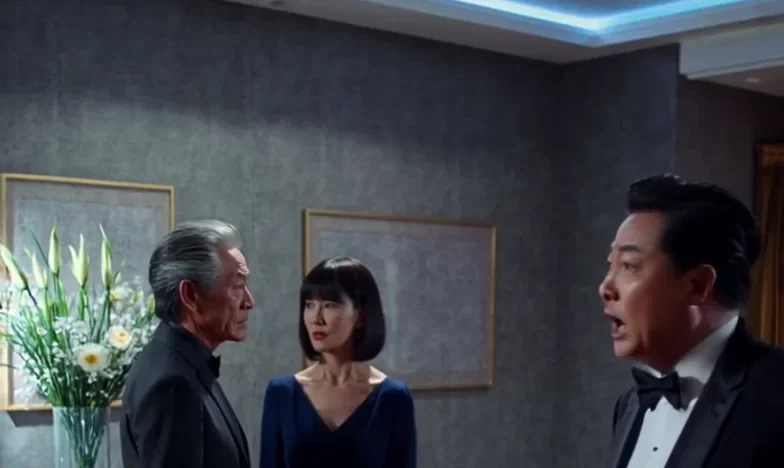
The Imperial Hotel was everything I expected. Marble floors, crystal chandeliers, the hushed murmur of wealth. The wedding hall was filled with people I recognized. Old business associates, former friends, relatives of Hiroshi’s. They all turned to look as we entered. I saw the shock in their eyes, the quick whispers behind raised hands.
Hiroshi was at the front of the room, talking to his best man. He saw me, and his smile faltered. His eyes flickered to Kenji, then back to me. He looked confused. Then, slowly, a look of dawning comprehension spread across his face.
The ceremony was a blur of flowers and music and vows I didn’t hear. Yumi was beautiful, of course. A perfect, porcelain doll. Hiroshi kept glancing at me, his expression unreadable.
At the reception, we were seated at a table near the back. A deliberate slight, I was sure. But Kenji didn’t seem to notice. He was charming, engaging the other guests in conversation, making them laugh. He was the most interesting person in the room, and everyone knew it.
Hiroshi made his rounds, stopping at each table to thank his guests. When he reached ours, his smile was strained. “Aiko,” he said, his voice tight. “Thank you for coming.”
“Congratulations, Hiroshi,” I said, my voice steady. “Yumi is lovely.”
He nodded, his eyes darting to Kenji. “And you are…?”
“Katsuragi Kenji,” Kenji said, extending his hand. “Aiko’s partner.”
Hiroshi shook his hand, his grip weak. “Partner,” he repeated. “I see.”
“Yes,” Kenji said, his smile pleasant but his eyes cold. “We work together. And other things.”
The silence stretched for a beat too long. Then Hiroshi forced a laugh. “Well, I’m glad you could make it. Enjoy the party.”
He walked away, his shoulders stiff.
The rest of the reception was a strange, surreal experience. People I hadn’t spoken to in years suddenly wanted to chat. They asked about my work, my life, my “charming companion.” I answered politely, but my mind was elsewhere. I was watching Hiroshi. He was drinking too much. His laughter was too loud. He kept looking at me, a mixture of anger and something else. Something that looked almost like fear.
A few weeks later, I heard the news. Takeda Industries was in trouble. A major investor had pulled out. There were rumors of accounting irregularities, of loans called in. The company was on the verge of collapse.
I didn’t know if Kenji had anything to do with it. I never asked. But I remembered the way he’d looked at Hiroshi at the wedding. The cold, calculating glint in his eyes. And I remembered the conversations we’d had about business, about ethics, about the kind of men who build empires on the backs of others.
The wedding was called off. Yumi’s family, it seemed, had no interest in marrying into a sinking ship. Hiroshi disappeared from the headlines. I heard he was living in a small apartment in Saitama, working for a former rival.
I didn’t feel triumphant. I didn’t feel vindicated. I just felt… tired. And a little sad.
Kenji and I continued to see each other. It wasn’t a whirlwind romance. It was something quieter, deeper. A companionship built on respect and shared experience. He never asked me to marry him. I never expected him to.
One evening, we were sitting on my balcony, watching the city lights. He took my hand. “Are you happy?” he asked.
I thought about it. My life wasn’t perfect. My son was struggling with his studies. My mother’s health was failing. Money was still tight. But for the first time in a long time, I felt like I was exactly where I was supposed to be.
“I’m getting there,” I said.
He squeezed my hand. “Good.”
We sat in silence for a while, the sounds of the city drifting up from below. I thought about Hiroshi, about the wedding, about the look on his face when he saw me with Kenji. I thought about the years I’d spent feeling small and insignificant. And I realized that I didn’t feel that way anymore.
I didn’t need to humiliate him. I didn’t need to take his company. I just needed to stand in that room, in that dress, with that man, and know that I was worth more than he’d ever given me credit for.
The rest, as they say, was just details.